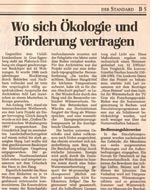
This article about Dr. Lari’s solar housing project Plabutsch was published in the Austrian newspaper Der Standard. This newspaper is the leading newspaper among educated readers (college or university
education). In Austria 352.000 people read it regularly. This daily newspaper was founded in 1988 and has since established itself as one of Austria’s leading newspapers. It reports on al topics, though many readers consider it emphasize politics and finance. The edition of Saturday/Sunday, November 27./28., 1999 published an article about Dr. Lari’s solar housing development project in their domestic architecture section. Maria Nievoll, an accredited Austrian journalist and architect authored this article.
The article describes Dr. Lari’s project and its benefits in terms of energy efficiency. Dr. Lari’s solar housing development Plabutsch is simple in its construction and principles, but has become a prototype building for setting a new standard in terms of green building. Its green roof and the positioning of the building near a group of trees integrate the building into the hill. The apartment complex consists of three units with 14 apartments each, which are connected through staircases. The positioning in the second third of the hill allows for optimum use of the preconditions of the surroundings, because this is the part of the hill’s slope which has the highest temperatures at night. The building is additionally protected from wind and resulting loss of heat by the hill and the group of trees. One of the main components for optimizing of energy is the glass façade. Dr. Lari designed the building facing southwards mainly. Shading is created with sun blinds which can be programmed to function automatically but also operated manually. Energy is also saved in terms of warm water production, because a solar facility which generates hot water. Rain water is collected and the design of the garages does not require additional lighting or ventilation. Because of all the measures, this building requires only 32 kWh/m2a energy for heating, in comparison to other conventional new
buildings require150‐200 kWh/m2a.
Article PDF (german)