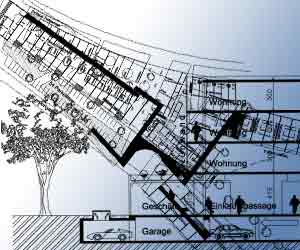
For each project, Dr. Lari develops an individual ecological strategy which takes into account the specificities of the building site and makes optimum use of its natural characteristics.
In Dr. Lari's construction projects, average heating energy consumption comes to 32 kWh/m²a, which corresponds to heating energy costs as much as 70% lower than those of comparable buildings.
Objectives
Low-energy buildings should be neither expensive nor elitist.
Strategies for energy optimization, and therefore lower operating costs, can always be implemented, without causing additional expenses in design and construction.
Average heating energy consumption comes to 250 kWh/m²a for Austrian building stock, to 120 kWh/m²a for new construction in accordance with the Heat Insulation Regulation of 1995, to 40 kWh/m²a for low-energy buildings and to 18 kWh/m²a for passive solar housing.
Fuel oil demand is scaled accordingly (see graph).
In Dr. Lari's construction projects, average heating energy consumption comes to 32 kWh/m²a, which corresponds to heating energy costs as much as 70% lower than those of comparable buildings.
As 70-80% of energy consumption in private households goes towards heating energy, these results mean a significant reduction of operating costs.
Applications
For each project, Dr. Lari develops an individual ecological strategy which takes into account the specificities of the building site and makes optimum use of its natural characteristics. Thus he creates the ideal framework for environment-friendly construction and minimized operating costs.
Before construction, the detailed simulation of heat transfers within the building, using state-of-the-art technology, is the precondition for efficiently planning heat storage elements and massive construction components.
Whether in housing or office buildings, hotels or industrial facilities, assessing and responding to the users’ needs and habits is a key element in keeping actual energy needs low. User manuals for completed buildings are an essential tool in making energy-saving potentials clear to the residents. Energy monitoring systems, which permit them to access their energy consumption and data for comparison via the Internet, provide an additional incentive for saving energy and cutting costs.
Strategies
Strategies for reducing pollutants caused by the construction and use of buildings can be applied in all phases and fields of construction. As early as the planning stage, future energy needs can be reduced by up to 40%.
As regards technical equipment, a well-considered choice of machinery yields an energy-saving potential of as much as 70%.
In addition, strategies for optimizing water circulation, consumption, recycling and removal, as well as the collection of precipitation, are integrated into Dr. Lari's projects at the planning stage. Measures for avoiding and reducing waste (composting) combine with these to achieve holistic ecological goals.
In a well-insulated building, controlled ventilation proves an efficient means of reducing heating energy needs without detracting from living comfort.
The finishing touch on Dr. Lari's ecological strategy is the use of building materials with environment-friendly life cycles during construction and maintenance.
Results
The effectiveness of a low-energy strategy can best be measured by the resulting reduction in operating costs.
Dr. Lari's projects are accompanied by research after completion so as to assess actual energy needs during the first years of use.
The project “Solar Housing Plabutsch” in Graz/Austria, a low-energy building constructed with state funding, was evaluated by means of a research project for three years after completion.
Empirical measurements pegged heating oil needs at only 5 l/m²a, even though outside temperatures dropped to –13°C in the winter.
Energy optimization strategies can equally be applied to reducing cooling load.
For the project “Holiday Inn Hotel“ in Amman/Jordan, the zones with the highest activity levels were planned within an artificial, grass-covered hill which serves as storage mass.
The facades of the guestroom floors, situated above the hill, were designed on the basis of energy simulations.
As a result, the hotel’s operating costs are as much as 50% lower than those of comparable buildings.