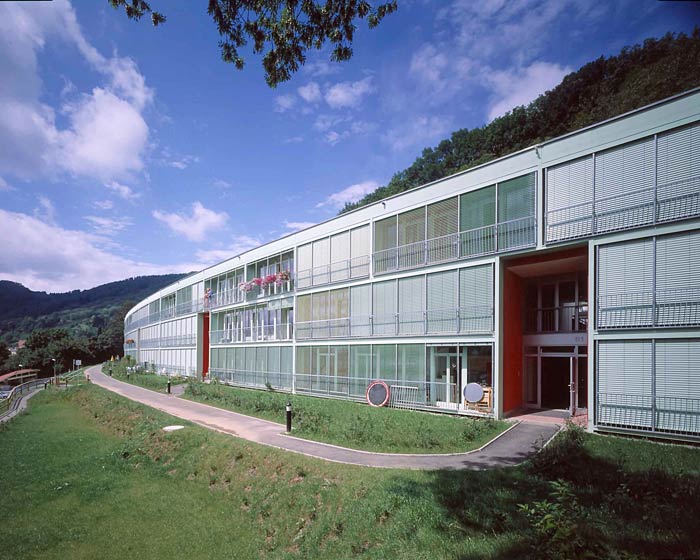
The goal of Dr. Lari is to improve living standards while reducing environmental impact through the development and realization of optimal solutions with the highest design quality. Whether urban planning, residential design or commercial development the individual and his/her needs is one central concern. The other is to develop a user-friendly ecology in each of his projects. Especially in the field of low energy housing conception, Dr. Lari has planned and realized both trend-setting and internationally acknowledged projects.
1991 Dr. Lari was awarded the Austrian National Housing Prize for the project „Solar Housing Plabutsch” in Graz. This project showed pioneer work in the field of solar housing, whereby energy costs were reduced by 70 %.
1992 Dr. Lari was awarded the Austrian Ecology Prize.
1998 Dr. Lari was nominated for the Austrian National Prize in Consulting of Exportable Services for the project Owainati Office Centre in Amman/Jordan. The project is a model development of work and lifestyle in the metropolis; an office complex that can be used around the clock.
In 2001 Dr. Lari was honoured to be nominated for the Austrian National Prize in Consulting of Exportable Services for the planning of the Holiday Inn in Amman.
Case study projects such as the ecological and economical renovation of pre-cast panel buildings or the development and implementation of strategies to reduce global warming are inherent parts of Dr. Lari's work.
Research projects regarding low cost, low energy housing, or the examination of end user behaviour to develop energy saving strategies have always been central in the works of Dr. Lari. Research, like solar cooling, is groundbreaking for the future of our climate and presents another focal point in the interest of Dr. Lari.
Integrated planning
Dr. Lari's wide experience in design, planning and construction is the basis of his guarantee that projects will be completed on schedule and within the given budget.
Architecture must be innovational and flexible to keep pace with the ever faster change in modern lifestyles, but also sustainable and far-sighted in order to form the backbone of the cities of the future.
Dr. Lari's work is marked by an emphasis on ecology.
Low-energy-buildings need not be expensive or elitist.
Strategies for energy optimization, and therefore a reduction of operating costs, can always be implemented, without causing additional costs in planning or construction.
Pillars
Four principles form the pillars of Dr. Lari's corporate strategy:
- Dr. Lari is completely indpendent and represents exclusively the interests of his clients.
- Sound cooperation with the client, i.e. reliability and strict adherence to contractual stipulations and target dates.
- In-depth analysis of the task at hand so as to propose optimum state-of-the-art solutions.
- Special attention to factors such as functionality, optimum operation and maintenance, safety and environmental compatibility, economic viability and sustainability.
Strategies
For each project, Dr. Lari develops an individual ecological strategy which takes into account the specificities of the building site and makes optimum use of its natural characteristics.
Thus Dr. Lari creates the ideal framework for environment-friendly construction and minimized operating costs.
Before construction, the detailed simulation of heat transfers within the building, using state-of-the-art technology, is the precondition for efficiently planning heat storage elements and massive construction components.
Whether in housing or office buildings, hotels or industrial facilities, assessing and responding to the users’ needs and habits is a key element in keeping actual energy needs low.
User manuals for completed buildings are an essential tool in making energy-saving potentials clear to the residents.
Energy monitoring systems, which permit them to access their energy consumption and data for comparison via the Internet, provide an additional incentive for saving energy and cutting costs.
Implementation
Strategies for reducing pollutants caused by the construction and use of buildings can be applied in all phases and fields of construction. As early as the planning stage, future energy needs can be reduced by up to 40%.
As regards technical equipment, a well-considered choice of machinery yields an energy-saving potential of as much as 70%.
In addition, strategies for optimizing water circulation, consumption, recycling and removal, as well as the collection of precipitation, are integrated into Dr. Lari's projects at the planning stage.
Measures for avoiding and reducing waste (composting) combine with these to achieve holistic ecological goals.
In a well-insulated building, controlled ventilation proves an efficient means of reducing heating energy needs without detracting from living comfort.
The finishing touch on Dr. Lari's ecological strategy is the use of building materials with environment-friendly life cycles during construction and maintenance.
The effectiveness of a low-energy strategy can best be measured by the resulting reduction in operating costs. Dr. Lari's projects are accompanied by research after completion so as to assess actual energy needs during the first years of use.