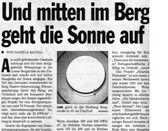
This article about Dr. Lari’s solar housing project Plabutsch was published in the Austrian newspaper Kleine Zeitung. This newspaper is based in Styria. The edition of Friday, April 30th, 1999 published an article about Dr. Lari’s project Solar Housing Development Plabutsch and and interview with him about this project. The article is authored by Daniela Blachal. She is a freelance journalist writing for several newspapers and magazine while her focus lies primarily with architecture.
Low‐energy‐houses can also be realized in subsidized buildings. The building is positioned on the Plabutsch in a way that makes a maximum use of the sun’s radiation and possibilities for heat storage. The achievements in saving of energy used for heating amounts up to 70% of the rates conventional new buildings require. Old buildings show figures between 300 and 400 kWh/m2a. Dr. Lari’s apartment complex is a milestone in Europe regarding green building. What makes this project unique is that these extraordinary achievements were made without the use of complex, complicated and expensive high tech equipment and under the terms and conditions that are applicable to subsidized housing. Simple elements like the optimum positioning of the building on the warmest part of the hill’s slope, the glass façade, the automatic sun blinds and the garages that require neither electric lighting nor additional ventilation were the key to achieving this efficiency in energy alongside allowed for an inexpensive in construction but energy efficient building. The newspaper edition also contains a short interview with Dr. Lari. The main focus of this interview is the energy efficiency of his project and the reasons for it. Dr. Lari is asked and answers that the 32 kWh/m2a use of heating energy are not the ideal case, because this calculation is based on figures an empty house has. When full, the figure can shrink to as little as 12 kWh/m2a. When asked, Dr. Lari answers that the positioning of the building is not the prime factor that leads to the high achievements in energy efficiency, but the behavior of the end‐user. Incorrect behavior can lead to a rise of 70%.
Article PDF (german)